In today’s AI-driven world, your models are only as powerful as the data that shapes them. To build intelligent systems that predict, classify, analyze, and respond with precision, you need data that is clean, correctly labeled, and contextually rich.
Our comprehensive data annotation services backed by decades of global expertise ensure your AI and ML models are trained with the accuracy, speed, and scale required to perform reliably in real-world environments.
Precise annotations help your AI detect patterns, understand nuance, and generate predictions that closely match real-world scenarios.
Clean, consistent training data reduces the time and computational resources needed for your model to learn, accelerating development and deployment.
Customized annotation tailored to your use case helps you build AI systems that outperform generic models giving you a clear edge in innovation and market differentiation.
Image annotation trains computer vision models to recognize objects, faces, scenes, activities, and environments with precision.
Key Image Annotation Techniques
Draw rectangular boxes around objects to help models identify and locate them within an image.
Used prominently in self-driving cars, retail analytics, surveillance, and object detection applications.
Outline complex shapes for tasks requiring pixel-level accuracy, such as medical imaging or environmental monitoring.
Mark specific points (e.g., joints, facial landmarks) to train models for pose estimation and facial recognition.

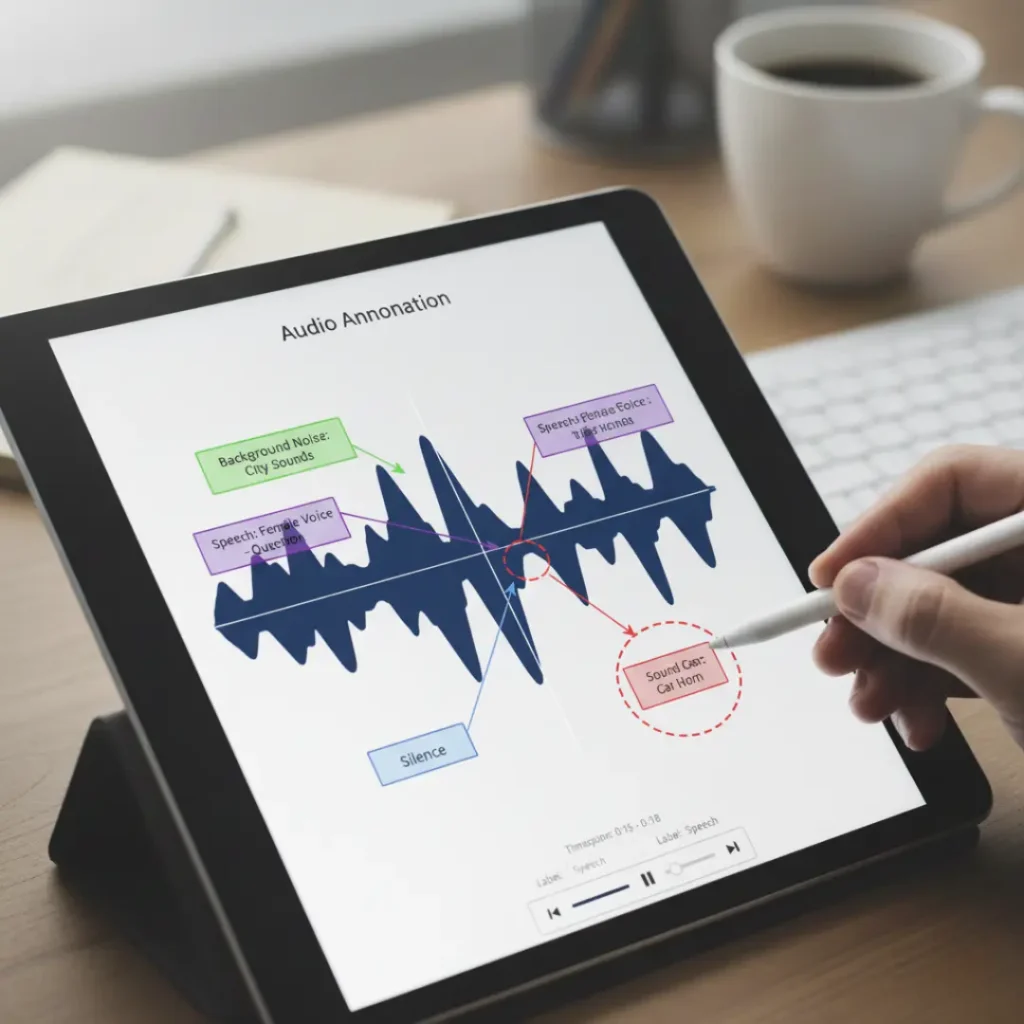
Audio is essential for training speech-enabled applications, voice recognition systems, and sound classification models.
Types of Audio Annotation
Convert audio to text to power ASR (Automatic Speech Recognition) systems.
Differentiate and label multiple speakers in an audio stream.
Label sounds such as alarms, footsteps, animal calls, or machinery noise for environment detection.
Analyze tone, emotion, and intent from spoken language to improve virtual assistants and customer service AI.
Text powers the core of many AI applications—from NLP systems and virtual assistants to content moderation and analytics. Our global workforce supports multiple languages, ensuring high-quality linguistic coverage at scale.
Types of Text Annotation
Tag emotional tone—positive, negative, or neutral—to enhance customer experience tools, social listening models, and safety systems.
Identify people, locations, organizations, products, dates, and more to strengthen classification, search, and automation.
Label the user’s purpose behind a query to improve chatbot understanding, routing accuracy, and conversational AI performance.
Highlight key concepts, keywords, and phrases to strengthen search relevance, semantic understanding, and context modeling.











Every great partnership starts with a conversation. Let’s begin ours
