28 SEPTEMBER 2026
Estimated reading time : 10 Minutes
Agentic AI in Procure-to-Pay: Where It's Actually Delivering ROI in 2026
For the better part of a decade, “automation” in accounts payable meant one thing: rules-based software that could read an invoice, match it to a purchase order, and route it for approval as long as nothing about the transaction fell outside a narrow set of predefined conditions. The moment a vendor changed its invoice template, a PO number was missing, or a tax line didn’t tie out, the exception landed back on someone’s desk.
That ceiling is what’s changed in 2026. Agentic AI — AI systems capable of making judgment calls, sequencing multi-step tasks, and adapting to exceptions without a human triggering every action has moved from pilot programs into production inside real US Procure-to-Pay (P2P) operations. Finance leaders aren’t asking “should we explore AI in AP?” anymore. They’re asking a harder, more useful question: where, specifically, is it paying for itself?
This article answers that question directly. We’ll walk through where Agentic AI in Procure-to-Pay is delivering measurable ROI today, which workflows are genuinely ready for it, how to measure the return honestly, and where controllers, AP leaders, and CFOs still need people in the loop. No hype. No claims that AI is replacing your AP team.
From Rules-Based Automation to Agentic AI: What Actually Changed
Traditional P2P automation OCR-based invoice capture, workflow routing, basic 2-way and 3-way matching solved the “read and route” problem. It didn’t solve the “decide and resolve” problem. A price variance of 3%, a duplicate invoice with a slightly different reference number, a vendor that’s changed its remittance bank account these still required a human to investigate, judge, and act.
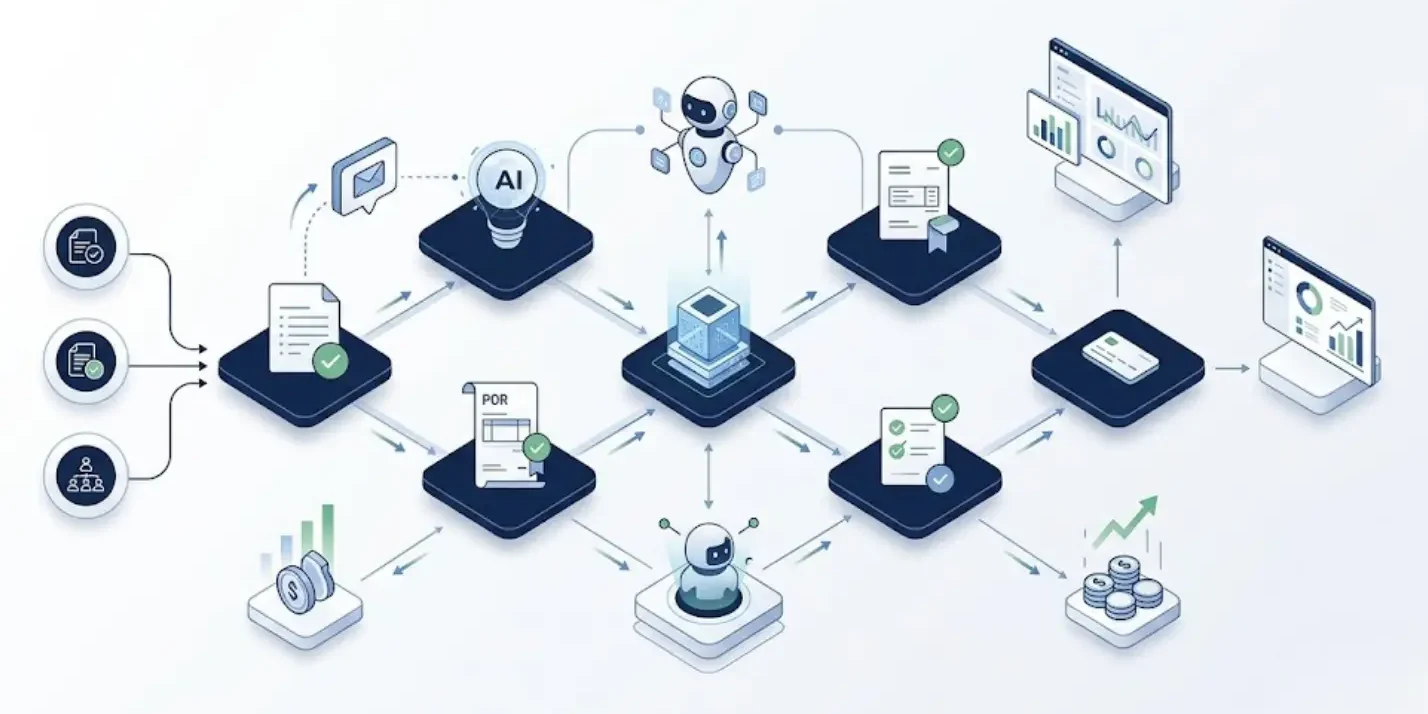
Agentic AI closes that gap. Instead of a single automation step, an AI agent can:
- Pull data from the ERP, the vendor invoice, the PO, and the receiving record simultaneously
- Identify why a match failed, not just flag that it failed
- Apply institutional rules and historical precedent to recommend or take a resolution action
- Escalate only the exceptions that genuinely require human judgment
For US finance teams running on NetSuite, Oracle, SAP S/4HANA, Microsoft Dynamics 365, or Workday Financials, this is a meaningful shift because most of the P2P friction in these environments has never been about capturing data. It’s been about resolving discrepancies across systems that don’t talk to each other cleanly.
Where Agentic AI in Procure-to-Pay Is Actually Delivering ROI
Not every part of P2P is equally ready for agentic automation. Based on where deployments are producing measurable results in US AP and procurement operations, four areas stand out.
1. Touchless Invoice Processing and AI Invoice Matching
This is the clearest, most consistently cited source of ROI. AI-powered accounts payable platforms are now handling a meaningfully higher share of invoice volume without human intervention — not just capturing invoice data, but performing AI invoice matching across 2-way and 3-way match scenarios and resolving minor variances (quantity rounding, freight allocation, unit-of-measure mismatches) autonomously, based on tolerance rules the AP team defines.
Where the ROI shows up:
- Reduced cost per invoice processed
- Fewer FTE hours spent on manual data entry and matching
- Faster cycle time from invoice receipt to approval-ready status
For US shared services centers processing tens of thousands of invoices a month across multiple ERPs or business units, moving even 30–40% of invoice volume from “touched” to “touchless” translates into real headcount reallocation, not just efficiency talk.
2. Exception Handling and Discrepancy Resolution
This is arguably where agentic AI earns its name. Traditional automation flags an exception and stops. An AI agent investigates it cross-referencing the PO, the contract terms, the vendor’s historical invoicing pattern, and prior resolution decisions and either resolves it within defined guardrails or presents AP staff with a recommended resolution and the supporting evidence.
This matters because exceptions, not clean invoices, are where most AP labor cost actually sits. Agentic AI is the first technology layer that meaningfully compresses that time rather than just routing the ticket faster.
3. Vendor Master Data Management and Onboarding
Vendor/supplier master data is a chronically underinvested area of P2P and a common source of both inefficiency and fraud exposure. Agentic AI is being used to:
- Validate new vendor records against external data sources (EIN/TIN verification, business registration status, bank account validation)
- Flag anomalies consistent with vendor impersonation or business email compromise attempts
- Detect duplicate vendor records created under slightly different names or addresses
- Monitor changes to vendor banking details and flag high-risk modifications for human review before payment
Payment fraud exposure is not a hypothetical concern for US finance teams. The 2026 AFP Payments Fraud and Control Survey found that 76% of US organizations experienced attempted or actual payments fraud in 2025, with business email compromise affecting 74% of organizations yet only 17% of organizations currently use AI to help combat it. That gap is exactly why vendor master data and payment-anomaly detection are high-ROI use cases even before agentic AI touches invoice volume.
4. Payment Approval Routing and Working Capital Optimization
Agentic AI is increasingly used to optimize when payments are made, not just whether they’re approved. Agents can analyze early-payment discount terms across the vendor portfolio, cash position, and payment timing rules to recommend which invoices to pay early for discount capture and which to hold to term a task that’s mathematically straightforward but operationally tedious to do consistently across thousands of invoices and hundreds of vendors.
The ROI here is direct and measurable: captured discount dollars, improved days payable outstanding (DPO) management, and better visibility into short-term cash forecasting all outcomes CFOs and treasury teams can quantify on a P&L or cash flow statement.
How US Finance Leaders Should Actually Measure ROI
Vague claims of “efficiency gains” don’t hold up in a CFO’s board deck. If you’re evaluating Agentic AI in Procure-to-Pay, measure it against metrics your finance organization already tracks:
- Cost per invoice processed before and after, segmented by touchless vs. exception-handled invoices
- Invoice cycle time receipt to approval, and approval to payment
- Touchless processing rate the percentage of invoices requiring zero manual intervention
- First-pass match rate for 2-way and 3-way matching specifically
- Exception resolution time average time to resolve a flagged discrepancy
- Early-payment discount capture rate dollars captured vs. dollars available
- DPO and working capital impact
- Vendor onboarding cycle time and downstream reduction in payment errors
- Fraud/anomaly detection rate flagged incidents before payment issuance
- AP labor reallocation hours shifted from manual processing to analysis, vendor relationship management, or control activities
A useful discipline: measure ROI in two buckets hard savings (labor cost, discount capture, error/fraud avoidance) and soft gains (cycle time, audit readiness, staff capacity for higher-value work). Boards and CFOs increasingly want both, but hard savings are what justify continued investment.
What Still Requires Human Oversight
This is the part vendors often gloss over, and it’s the part that matters most for controllers and AP leaders responsible for internal controls.
Segregation of duties still applies to AI agents. If an agent can both resolve an invoice discrepancy and release it for payment, that’s a control design problem, not a feature. US finance organizations particularly public companies subject to internal control requirements under Section 404 of the Sarbanes-Oxley Act need to define which decisions an agent can make autonomously, which require a human approval step, and how that boundary is documented and auditable. Agentic AI doesn’t eliminate the need for segregation of duties; it changes where the duty boundary sits.
Judgment on ambiguous or high-value exceptions still belongs to people. An agent can resolve a $200 quantity variance based on historical pattern-matching. A $75,000 pricing dispute with a strategic supplier, or an unusual payment request that deviates from a vendor’s established pattern, still warrants a controller’s or AP manager’s review not because the AI can’t process it, but because the cost of an error is asymmetric.
Vendor relationships remain human. Negotiating payment terms, resolving disputes that touch the commercial relationship, and managing strategic supplier conversations are not and shouldn’t be agent-led activities.
Audit trail integrity requires deliberate design. Auditors and audit committees will ask how an AI agent’s decision was made, what data it used, and who reviewed it. If your agentic AI deployment can’t produce a clear, timestamped decision trail, you’ve traded one control gap for another. This is a genuine consideration before implementation, not an afterthought.
Model drift and data quality need ongoing monitoring. An agent trained on historical resolution patterns will reflect the quality and the blind spots of that history. Finance leaders should expect to periodically review agent decisions, not deploy and forget.
None of this means Agentic AI can’t be trusted with real P2P workflows. It means the trust has to be structured, bounded, and monitored the same discipline finance teams already apply to any internal control.
What US Businesses Should Consider Before Implementation
Before committing budget to an agentic AI initiative in P2P, mid-market and enterprise finance leaders should work through a few foundational questions:
- Is your underlying data clean enough? Agentic AI performs only as well as the vendor master data, PO data, and historical transaction data it’s working from. Organizations with fragmented ERP environments or inconsistent vendor records will see slower, messier ROI than those with clean, centralized data.
- What’s your current touchless processing baseline? You can’t measure improvement without knowing your starting point. Many US AP teams overestimate how automated they already are.
- Does your control framework already define decision boundaries? If your organization hasn’t mapped which AP decisions require dual approval, segregation of duties, or specific documentation, that mapping needs to happen before not after agent deployment.
- Is this a build, buy, or outsource decision? Some organizations have the internal finance transformation bandwidth to implement and govern agentic AI themselves. Many mid-market companies don’t and this is increasingly where Finance & Accounting outsourcing partners add distinct value: not replacing the technology decision, but operating it with the process discipline, control design, and change management most internal AP teams don’t have spare capacity to build from scratch.
- How will you handle the transition period? The shift from manual and semi-automated P2P to agentic workflows isn’t instant. Expect a period where staff are reviewing agent decisions more closely than they will once trust and accuracy are established that’s a feature of responsible rollout, not a sign the technology isn’t working.
Where Agentic AI Fits Alongside F&A Outsourcing
For many US mid-market and enterprise finance organizations, the real question isn’t “AI or outsourcing.” It’s how the two work together. Agentic AI handles the pattern-based, high-volume decisioning inside P2P. A Finance & Accounting outsourcing partner brings the process governance, the exception-handling expertise for the judgment calls that remain, and the operational bandwidth to run a P2P function that’s technology-enabled without requiring your internal team to become AI infrastructure managers.
This is the model taking hold across US finance shared services in 2026: technology-enabled finance operations, where AI-driven finance operations reduce transactional load and outsourcing or shared services partners supported by finance management consulting expertise provide the operational depth, control rigor, and scalability to run the function end to end. For more on how this shift is playing out across F&A functions more broadly, see Viaante’s take on F&A outsourcing trends for 2026 and how AI in finance is moving from transactional to predictive.
The Bottom Line
Agentic AI in Procure-to-Pay isn’t a future promise anymore it’s producing quantifiable ROI today in touchless invoice processing, exception resolution, vendor master data integrity, and working capital optimization. But it’s not a replacement for AP judgment, internal controls, or the people who manage vendor relationships and handle the exceptions that genuinely warrant a second look.
The finance leaders getting real value from this technology in 2026 are the ones treating it the way they’d treat any other control-sensitive process change: with clear metrics, defined decision boundaries, and a realistic view of what still needs a human. That’s not a cautious take it’s the difference between an AI initiative that shows up in your ROI numbers next quarter, and one that shows up in your audit findings instead.